
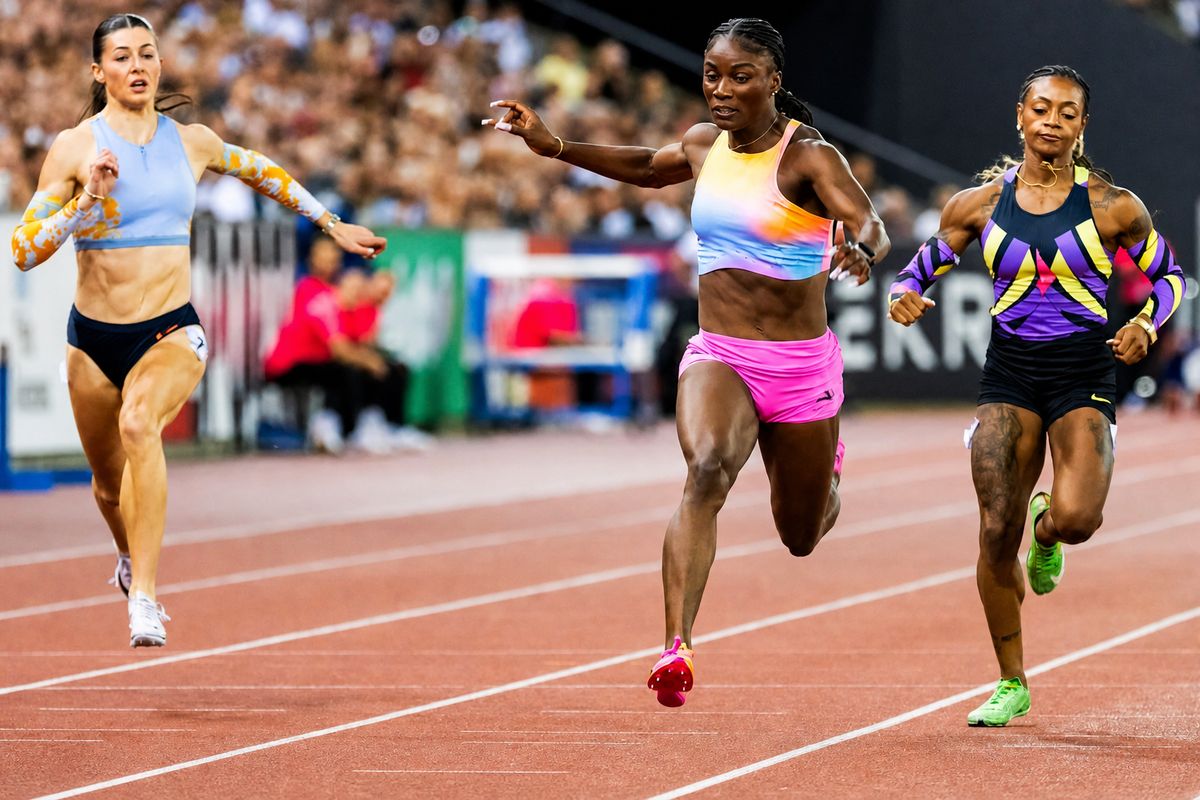
Amy Hunt Diamond League step up lands with a thud, and that is the point
Amy Hunt Diamond League outings in Switzerland deliver a neat, slightly brutal lesson about elite sprinting in 2026. A few weeks after a history making European Championships, Hunt finds herself in two very different Diamond League tests, second in the 200m in Lausanne and fifth in the 100m in Zurich. The times are solid, the placing is respectable, and the gap to the very top is still obvious. That combination is exactly why these races matter.
In Zurich, the women’s 100m is not a gentle reintroduction. It is a proper heavyweight scrap between Olympic champion Julien Alfred and world champion Melissa Jefferson Wooden, separated by five thousandths of a second, both timed at 10.70sec. Sha’Carri Richardson takes third in 10.97sec. Hunt runs 11.04sec for fifth. It reads like a reality check, because it is one, but it is also a marker laid down for what “world class” actually looks like when the biggest names turn up and run hard.
And in Lausanne, the story is similar but with a slightly softer edge. Hunt returns to the 200m and is beaten by American Kayla White, 22.18sec to 22.32sec, with Nigeria’s Favour Ofili just behind in a photo finish. Hunt admits she feels “tired before the race” and “pretty stiff” in her pre competition. That is not an excuse so much as a reminder of the calendar reality. Winning four European golds takes something out of an athlete, even one riding a wave of confidence.
Zurich Diamond League 100m, a title holders’ duel and Hunt’s 11.04
The Zurich Diamond League women’s 100m is defined by the front of the race, not the middle. Alfred and Jefferson Wooden establish themselves as a class above the rest, both stopping the clock at 10.70sec, with Alfred edging it by the tiniest margin, five thousandths of a second. That detail matters because it shows how refined the margins are at the top. There is no room for a slightly off start, no space to tighten up at 60 metres, no forgiveness for tired legs.
Behind them, Richardson’s 10.97sec for third underlines the depth of the field. Hunt’s 11.04sec for fifth is not a collapse, it is a competitive time in a brutal line up. Hunt herself frames it as a process race, saying she is not thinking too much about the time and instead wants to “make a good show” of herself. She notes she comes in with the slowest season’s best in the field and with “very, very tired legs”, and still leaves happy with fifth. Fair enough. In a Diamond League 100m like this, surviving the first 30 metres without panic is half the job.
There is also a psychological value that is easy to miss if the focus stays on the clock. Hunt says before the race she is “so excited” to be in a position to race against some of the greatest. That is not star struck talk, it is a recognition that sprinting is a craft learned at speed. The best sprinters do not just run fast, they execute under pressure, in packed stadiums, with cameras in their faces, and with the knowledge that one mistake becomes a headline.
Lausanne Diamond League 200m, second place and the cost of a gold rush
In Lausanne, Hunt takes on the 200m and finishes second in 22.32sec. Kayla White wins in 22.18sec. The margin is not huge, but it is decisive. Hunt’s race is also complicated by the fact she has to fight off Ofili in a photo finish, which tells its own story about competitive sharpness. When an athlete is not quite fresh, the back end of a 200m can feel like running through wet cement, and holding form becomes a battle of will.
Hunt is candid afterwards. She says she feels tired before the race and stiff in her pre competition. That lines up with the broader narrative of her season, because she arrives in Switzerland straight off an extraordinary European Championships in Birmingham. The Diamond League is not a victory lap. It is a different ecosystem, with different expectations, and with rivals who are not impressed by medals won a fortnight earlier.
There is also a jolt of drama in the same race. Jamaica’s Shericka Jackson, described as a two time former world champion in the event, pulls up with 70 metres to run. The source material does not provide details on the nature of the issue, so it would be wrong to speculate. But the moment is a reminder of how thin the line is between peak performance and a season changing setback, especially in a schedule that asks sprinters to bounce between championships and one day meets at full intensity.
From Birmingham to Switzerland, who Amy Hunt is in 2026
Hunt’s recent rise is not framed as a slow burn in the source material, it is framed as a burst of history. At the European Championships in Birmingham, she becomes the first athlete to win four gold medals in a single edition of the event, taking the 100m, 200m, women’s 4x100m relay and mixed 4x100m relay. That is a rare combination of individual speed and relay reliability. It also means she runs a lot of rounds and a lot of high intensity metres in a short window.
Those Birmingham wins change her status. She is no longer just a promising British sprinter, she is a European champion with a target on her back and a new set of invitations. The Diamond League is part of that. It is where athletes learn what the global standard feels like, not in theory, but in the warm up area, in the call room, and in the first 20 metres when everyone around them is also a 10.7 or 10.8 runner on their day.
And there is a strategic layer too. Hunt is already talking about learning what times are needed to compete before the World Championships next year in Beijing. That is a useful detail because it shows she is not treating Zurich as a verdict on her ability. She is treating it as information. The gap between 11.04 and 10.70 is not just 0.34 seconds, it is a whole world of start mechanics, acceleration, relaxation, and race modelling. Closing it is hard, but at least now it is visible.
Amy Hunt Diamond League results in context, the sprinting hierarchy is unforgiving
It is tempting, especially in a post medal glow, to treat a Diamond League appearance as a natural continuation of success. But the sprinting hierarchy does not work like that. In Zurich, the top two are separated by five thousandths of a second at 10.70sec. That is the level where athletes are not racing the field, they are racing the clock and each other’s execution. Hunt’s 11.04sec is close enough to be in the conversation, but not close enough to control the conversation.
What makes this particularly instructive is the contrast between events. Hunt is second in the 200m in Lausanne, then fifth in the 100m in Zurich. That does not mean she is “better” at one and “worse” at the other, it means the depth and shape of each field matters. The Zurich 100m is stacked with the sport’s headline names. The Lausanne 200m, while still high quality, plays out differently, and Hunt is able to compete for the win even while feeling tired.
There is also a broader British angle. British sprinting often lives in the space between European dominance and global contention. That is not a criticism, it is just the reality of how deep the United States and Caribbean sprint systems can be, and how often global medals are decided by athletes who have been running world class times since their teens. Hunt’s Birmingham haul is a breakthrough. Zurich is the reminder that breakthroughs are the start of the argument, not the end.
And importantly, Hunt does not sound rattled. She talks about process, about being equipped by the experience, and about aiming high. That mindset matters because the Diamond League is as much about learning to repeat performances as it is about producing a single peak. The athletes who end up with global medals are usually the ones who can show up, again and again, and run close to their best even when the legs are heavy.
Swiss meets, big middle distance storylines and a sport chasing records
Hunt’s races sit inside two meetings that also underline where athletics is in 2026. In Zurich, there are two world records mentioned in the source material. Brazil’s Alison dos Santos breaks the 400m hurdles record set in 2021 with a time of 45.80sec, winning by a wide margin. In the women’s 100m hurdles, Masai Russell wins in 12.09sec, beating the previous best ever mark of 12.12sec set in 2022. Those are not small improvements, they are meaningful nudges forward in events where progress is usually incremental.
But the record chase is not always rewarded. Armand Duplantis fails to set another world record, with three failed attempts at 6.32m. That detail is useful because it shows how the sport is currently framed. Records are treated as the headline currency, even when the competition itself is outstanding. Sometimes the bar goes up and the athlete says no. That is sport. It is not always neat.
In Lausanne, and also in Zurich according to the source material, Switzerland’s Audrey Werro is a central figure in the 800m. She wins on home soil with a personal best of 1:53.70 in Zurich, and is described as the only runner to have gone under 1min 54sec this year. The historical hook is obvious. Jarmila Kratochvilova’s 1:53.28 from 1983 remains the longest unbroken world record in athletics, and Werro’s run is 0.42 seconds shy. The Guardian adds important context, noting the record is highly contested because it comes from a period when systemic doping was prevalent, while also stating Kratochvilova never failed a doping test.
There are British middle distance notes too. Keely Hodgkinson withdraws from the women’s 800m in Zurich saying her body is “not quite ready”. Georgia Hunter Bell finishes third with a season’s best 1:55.03. Hunter Bell has just won her third major gold of the year in the 1500m in Birmingham, having prioritised the longer distance over the 800m. The point is not that Britain is suddenly an 800m powerhouse, it is that the Diamond League forces choices. Athletes cannot do everything, not at full tilt, not without consequences.
The learning curve that medals do not show, fatigue, execution and the next season
The most revealing thread running through Hunt’s Swiss double is fatigue, and how openly it is discussed. Hunt talks about tired legs in Zurich and feeling stiff in Lausanne. That is not exactly groundbreaking, elite athletes get tired, but it is still refreshing to hear it framed without melodrama. Sprinting is often sold as pure explosiveness, yet the reality is that it is also about managing load, travel, rounds, and the mental drain of being “on” all the time.
There is a technical lesson too, even if the sources do not dive into mechanics. The difference between 10.70sec and 11.04sec is not simply “run faster”. It is start reaction, first step efficiency, transition to upright running, and the ability to maintain relaxation at maximum velocity. When Alfred and Jefferson Wooden are separated by five thousandths, it suggests both are executing at an extremely high level. For Hunt, racing them is a way of seeing that execution up close, then taking it back to training with something concrete in mind.
And then there is the calendar. Hunt is already looking ahead to the World Championships next year in Beijing. The sources do not provide qualification standards or selection details, so those cannot be stated here. But the direction of travel is clear. Hunt uses 2026 to establish herself as a European champion and Diamond League regular, then uses the experience to sharpen what is needed to contend globally. That is the normal pathway for athletes who make the jump from regional success to world finals, and it is rarely linear.
What this moment signals for British sprinting, and why fifth can be progress
British athletics loves a champion, and Hunt has given it a big one in Birmingham. Four gold medals in one European Championships is the kind of achievement that changes how an athlete is covered and how they see themselves. But the Diamond League is the place where reputations are tested against the sport’s deepest pools of talent. Hunt’s fifth in Zurich is not a failure, it is a data point. It says she belongs on the start line, and it also says the podium is still a hard climb.
There is also something healthy in the way this plays out publicly. Hunt is not pretending she is already at the level of Alfred or Jefferson Wooden. She is saying the line up is crazy competitive, she is saying her legs are tired, and she is still taking satisfaction from being fifth. That is a professional response, and it matters because the pressure on a new champion can be suffocating. If every race has to be a win, the season becomes a trap.
And for the sport itself, these meetings show the full spectrum in one week. A sprinter coming down from a European high, an 800m star chasing a controversial decades old record, world records falling in the hurdles, and a pole vault great failing to add another line to his own legend. Athletics in 2026 is not short of storylines. Hunt’s is one of the more relatable ones, because it is about the gap between being brilliant and being the best, and the work required to cross it.
The next chapter is not written in Zurich or Lausanne alone. But the outline is there. Hunt now knows, in her bones, what 10.70 looks like from lane level. She knows what it feels like to race while tired and still compete for second. And she knows that aiming for the stars, as she puts it, starts with turning these reality checks into routine.